Marine Bird Mapping and Assessment
Mapping the Distribution, Abundance and Risk Assessment of Marine Birds in the Northwest Atlantic Ocean
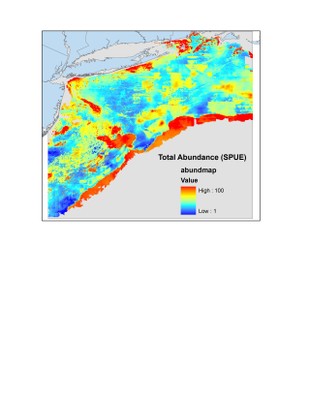
This project will develop a series of maps depicting the distribution, abundance and relative risk to marine birds from offshore activities (e.g., wind energy development) in the northwestern Atlantic Ocean. The maps are intended to be used for informing decisions about siting offshore facilities; marine spatial planning; and other uses requiring maps of seabird distributions.
This project will develop a series of maps depicting the distribution, abundance and relative risk to marine birds from offshore activities (e.g., wind energy development) in the northwestern Atlantic Ocean. Our goal in this effort is to develop and demonstrate techniques to document and predict areas of frequent use and aggregations of birds and the relative risk to marine birds within these areas. The resulting map products are intended to help inform decisions about siting offshore facilities; marine spatial planning; and other uses requiring maps of seabird distributions.
This North Atlantic LCC project is supporting several components of map and technique development by leveraging several large, ongoing projects funded by BOEM, DOE, USGS, and NOAA and involving research groups at the Biodiversity Research Institute, NC State University, CUNY-Staten Island, the USGS Patuxent Wildlife Research Center, and the NOAA National Centers for Coastal Ocean Science-Biogeography Branch.
To accomplish this work we need to identify seasonal distribution and abundance patterns, movement patterns, habitat-abundance associations (including prey), and the potential risk to a particular species based on life history traits, behaviors or species’ vulnerabilities. Currently, information on the spatial and temporal movement and occupancy patterns of wildlife resources in offshore habitats is lacking for much of the North and Mid-Atlantic Planning Regions. This project will integrate data from a number of ongoing marine bird survey efforts including but not limited to ships of opportunity surveys conducted by City University of New York, AMAPPS aerial and ship-based surveys, ongoing telemetry studies of individual marine birds (sea ducks and seabirds) by a number of entities, state-funded studies gathering baseline information, the USFWS sea duck surveys and data from Canadian surveys in the Gulf of Maine.
This project also will integrate with and inform work underway by NOAA’s Biogeography Division who are predicting seabird occurrences in the mid-Atlantic and New York Bight. This project will support work underway by The Nature Conservancy, which is developing an estuarine and marine habitat classification system from Maine to Virginia using NOAA and NatureServe’s Coastal and Marine Ecological Classification Standard (CMECS) and the Nature Conservancy and NatureServe’s Northeast Regional Habitat Classification System (NRHCS).
A workshop will be held to identify and quantify risk factors using a Structured Decision Making (SDM) process for marine birds in the Northwest Atlantic. The results from this workshop will be combined with data from the studies and surveys mentioned above, to create a map of relative risk to marine birds based on patterns of use, abundance and temporal variability that will inform current and future decisions by natural resource managers.
Read the original project proposal.
| Project ID | NALCC_2011_07 |
|---|---|
| Project URL | link |
| Start Date | 01 May 2012 |
| End Date | 30 June 2014 |
| Project Leader | |
| Organization | |
| Contact phone (work) | (919) 513-7558 |
| Contact phone (mobile) | |
| Contact fax |
North Carolina State University expanded its study area from Nantucket Sound to a region encompassing most of the north Atlantic coast. Spatial models (risk maps) have been prepared for nine species (Common Eider, Common Loon, Great Black-backed Gull, Greater Shearwater, Herring Gull, Long-tailed Duck, Northern Gannet, Surf Scoter, and Wilson’s Storm Petrel). The Biodiversity Research Institute is continuing to update seabird data for the USGS Atlantic Seabird Compendium so that they can be used by NC State in modeling. Richard Veit completed review of the historical USGS database on marine birds to correct apparent errors (e.g., mislabeled species) and advise how to handle uncertainties in bird identification. Brian Kinlan (contractor to NOAA) continues to help coordinate work with other investigators.
In September 2013, a no-cost 6-month extension to the subaward given to PI Beth Gardner was granted.
In August 2013, a seminar was given that discussed progress towards developing maps depicting the distribution, abundance and relative risk to marine birds from offshore activities (e.g., wind energy development) in the northwestern Atlantic Ocean.
Quarterly Reports
NALCC Funding- $145,000
Marine Bird Mapping Science Seminar, August 8, 2013
Document Actions
 NEWS
NEWS HELP
HELP